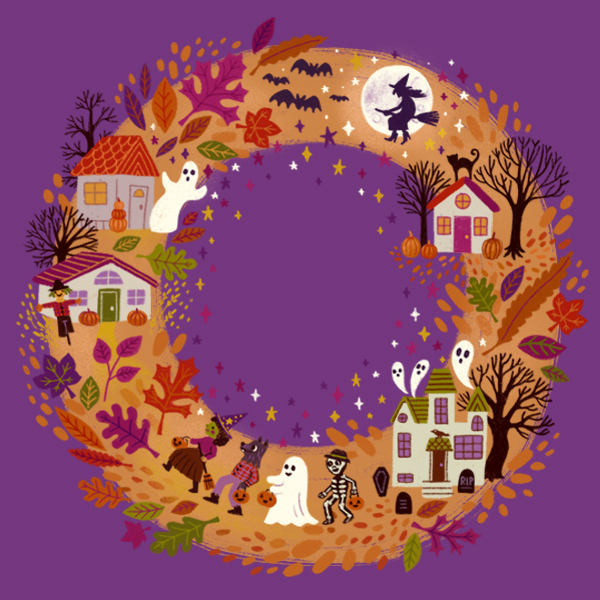
Halloween has been celebrated for a VERY long time. Like, thousands of years. So, it’s likely that present-day Halloween is a hodgepodge of many different customs and beliefs from multiple time periods and regions of the world. These are the ones that likely had the biggest influence on the holiday.
Samhain
One of the most popular theories about the history of Halloween is that it evolved from the Gaelic festival Samhain, which was celebrated by Celtic pagans. Samhain (pronounced SAH-win) marks the end of the harvest season and the beginning of winter. It is also considered a threshold festival, meaning the boundary between this world and “the Otherworld” is considered blurred. In other words, some believe that the veil is thin between the living and the dead.
Samhain included large feasts, gatherings, bonfires and offerings made to ward off evil spirits and to improve the chance of people and livestock surviving the winter. Some also believed that the souls of passed family members would return home for the night, so it was customary for there to be a place setting for them at the table.
A custom similar to trick-or-treating was referred to as “guising.” People dressed up, went from door to door, and chanted to get treats. Some believe that the costumes were meant to disguise celebrants from the spirits—particularly vengeful ones.
Divination, the practice of completing a kind of occultic ritual in order to see into the future or gain insight about a situation, was also a big part of Samhain, often using apples, nuts and/or bonfires. This is where bobbing for apples comes from! Whether or not someone managed to bite a bobbing apple was thought to mean all sorts of things about their love life.
Samhain is thought by some to have been Christianized by the church and renamed All Hallow’s Day.
All Hallow’s Day
Another popular theory is that Halloween is a Christian holiday independent of Samhain, purely connected to All Hallow’s Day or All Saints’ Day. It’s a time when Christians honor saints and pray for the recently departed to make it to heaven.
Traditions for this theory include ringing church bells, criers dressed in all black ringing hand bells and calling on Christians to remember passed souls, and baking and sharing soul cakes (a shortbread-like cookie flavoured with seasonal spices and etched with the symbol of the cross).
The act of “souling” is another theory for the origin of trick-or-treating, as groups of people would go from door to door to get soul cakes and, in return, pray for the passed loved ones in their community. Soul cakes were also sometimes left as an offering to the souls themselves.
Some say people used to carry lanterns made of hollowed-out turnips while they went souling, both to represent the souls of the dead and to ward off evil spirits. Other root vegetables were also used, and some were placed as decor to help lead visiting spirits back to their homes.
Similar to Samhain, dressing up in costume was often associated with warding off spirits. The tradition of costume parties might be connected to what some Christians called the danse macabre, when spirits allegedly rose from the dead on Hallow’s Eve for their own celebration.
When is Halloween celebrated?
Regardless of its origins, Halloween is always celebrated on the night of October 31 each year. This means that Halloween night can be a late night—for both kids AND parents—if it falls on a weekday.
This is part of the reason why schools, churches and family organizations in the U.S. often choose to organize their own Halloween celebrations (e.g., “Trunk-or-Treat”) the weekend before Halloween. It’s also a fun, safe way to prolong the festivities!